
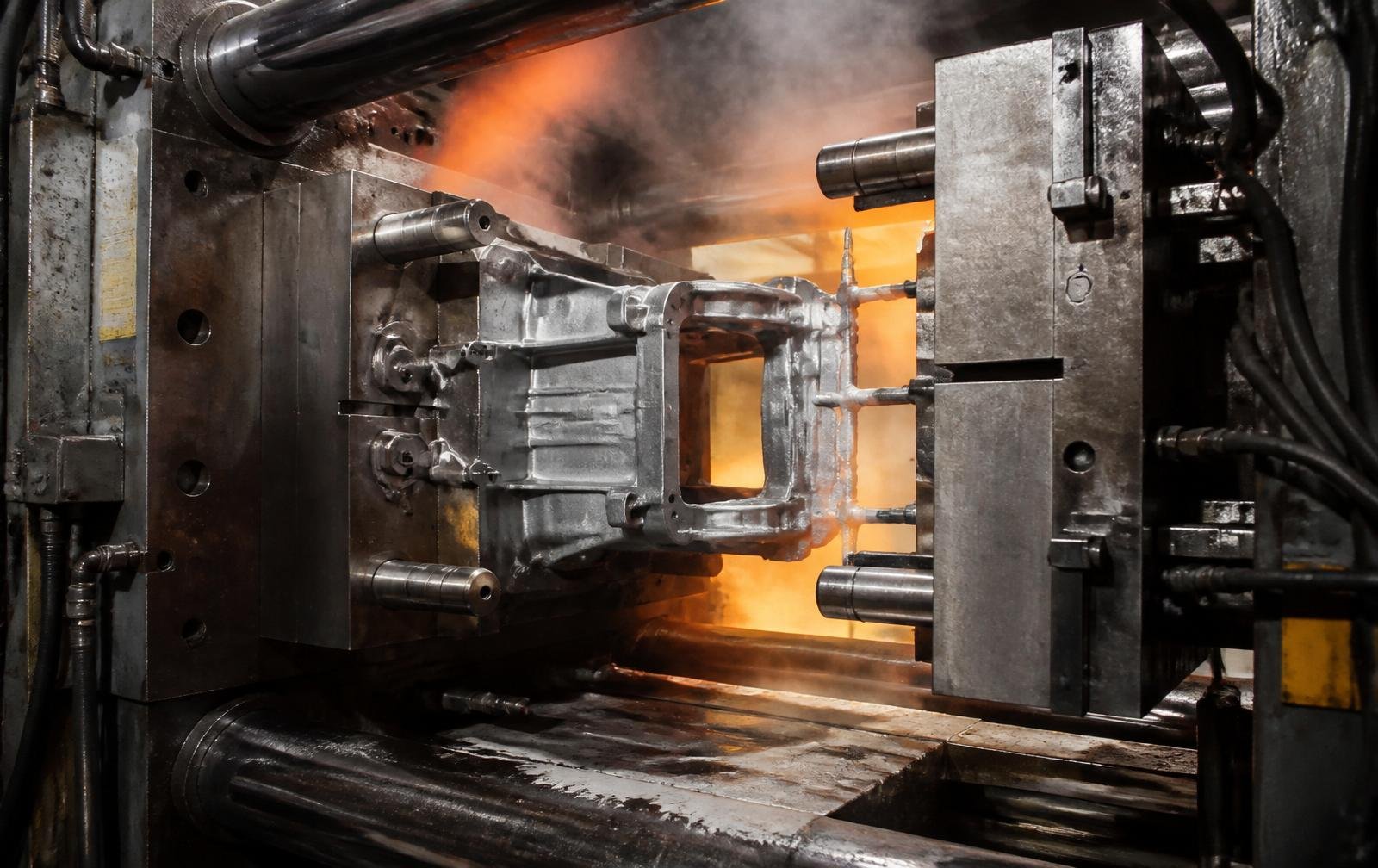
High-Pressure Die Casting
Die casting, with the tool built in-house
We take responsibility for the die as well as the part, so production quality stays consistent run after run.
Casting at a glance
- Alloys
- Aluminium & zinc
- Tooling
- Designed and cut in-house
- Finishing
- Trim, machine, coat
- Quantities
- Low to high volume
Why high-pressure die casting
Molten alloy is injected into a hardened steel die at high pressure, filling thin walls and fine detail in seconds. The result is a dimensionally stable metal part with good surface quality, produced at a cycle time that makes volume work economical.
Because we design and cut the die ourselves, changes during development do not mean waiting on a third-party toolmaker — and the same team that machines the tool also machines the finished casting.
Process
From die design to finished casting
01
Part & die design
Draft, wall thickness, gating and ejection reviewed against your model.
02
Tool manufacture
Die blocks and inserts cut, hardened and fitted in our own tool room.
03
Sampling
First shots produced, measured and corrected before release.
04
Production & finishing
Casting, trimming, machining, coating and inspection.
Design guidance for castings
- Maintain uniform wall thickness — typically 2 to 4 mm in aluminium
- Apply at least 1° draft on all vertical faces, more on textured surfaces
- Add generous fillets; sharp internal corners crack dies
- Use ribs rather than thick sections to add stiffness
- Plan the parting line early — it drives tool cost
- Leave machining stock on critical mating surfaces
Planning a cast component?
Send your CAD file, drawing or sample part — an engineer reviews every enquiry and replies with material, tolerance and lead-time options.